Expand Cut Tags

No cut tags
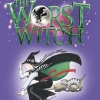
pobble_reads: Book cover of “The Worst Witch” by Jill Murphy (Default)
The obvious blessing in this chapter is for Mildred and everyone else who is living with fear - whether it's a nebulous anxiety/phobia like Mildred's fear of the dark or fear of something more concrete. May the be comforted and safe.

My less obvious blessing is for whoever embroidered the samplers with quotes from the Book of Spells that every pupil had in the otherwise plain rooms. My headcanon is that stitching them is something the final year students do to welcome the next lot of first years who will take over their bedrooms - but it could be one particular teacher who makes them or was a group project one particular year and they've just lasted well - but whoever made them they seem to be the only decoration and hint of specialness that the pupils have in their rooms. I hope that they help then to feel more at home and cared for as well as helping them to remember the spells. I'd like to bless everyone who creates beauty and homleyness - may they also be welcomed, nurtured and surrounded by beauty and skilled crafting
pobble_reads: Book cover of “The Worst Witch” by Jill Murphy (Default)
So for reading The Worst Witch I've decided to alternate between Lectio Divina and PaRDes for each chapter - and to do a whole book Florilegia at the end. I'm choose a sentence for the four step reading practice that's different from the sparklet I choose for Florilegia but something that jumps out at me as being interesting and juicy. I did thing about choosing a sentence to do Lectio or PaRDeS randomly but can't work out a good way to do that.

For this chapter I'm going to be looking at the sentence: You could rely on Mildred to have her hat on back-to-front or her bootlaces trailing along the floor

it appeals to me because it's very much how I was a not-yet-diagnosed-with-dyspraxia schoolchild (although our uniforms didn't include hats they did have ties from the age of 5 which I think would be challenge even for an averagely well coordinated Small!)

As a quick reminder because I've not be posting here in ages Lectio Divina is a four step Practice:
Lectio - the literal reading and narrative
Mediatio - the allegory, symbols and metaphors
Oratio - reflection - how is this text connected with my own life?
Contemplatio - the invitation - what action is this text prompting me to take?

I’ll put my thoughts in the comments. Please do join in
pobble_reads: Book cover of “The Worst Witch” by Jill Murphy (Default)
In this first chapter we are introduced to Miss Cackle's Academy for Witches - at the top of a high mountains surrounded by a pine forest - and learn a little about its traditions and rules sand how there seemed to be tests and exams every week. We are also introduced to Mildred Hubble a first year who is one of those people who always seem to be in trouble with he hat on back-to-front or her bootlaces trailing along the floor and her best friend Maud who stays loyally with her through everything, however hair raising. It's half way through Mildred and Maud's first term and Cackle's and is the night before they will each be presented with a back kitten. Which they will have to train to ride behind them on the broomsticks they have only just mastered riding themselves. They are sitting in Mildred's room talking about their plans when their terrifying form-mistress Miss Hardbroom interrupts and sends Maud to bed. Once Mildred is left alone we learn her secret - she is scared of the dark....

Humility seems a very appropriate theme for two first years at the very start of their education in witchery (witching? witchcraft? I'm not actually sure if witches are who they innately are or something they have to learn how to be?). They are very aware of being the youngest and least experienced class in the school. They have to learn to ride a broomstick, one of the most basic and defining characteristics of an adult witch and it's takes quite a long time and isn't near;y as easy as it looks. While the older pupils (and presumably teachers) are flitting like bats above the playground wall That must be a humbling experience? Or does being surrounded by the older classes who have successfully learned all these things act as more of an encouragement rather than something to compare yourself with unfavourably? The idea of having a "beginners mind" is a humble position but not a humiliating one. (I'm struggling to fully untangle humiliating from humility - they obviously come from the same root but have ended up in different places).
The whole system of the school with its dingy black uniforms and identical bedrooms and all thee rules, traditions and exaptations seems designed to take away some of their individuality - but also to give them a sense of belonging. I'm not sure if that leads more to individual humility or group pride? Probably both at different times. An institution like a school needs to have more formal rules than a family home might in order to run smoothly but the traditionalism and strictness of Cackle's does seem particularly harsh. There are lots of interesting questions about how institutions and groups can establish normals and have enough homogeneity and harmony to function with crushing individuality and risking humiliation for newbies and those who struggle to fit in.

For Mildred school seems to be a particularly humbling/humiliating experience she couldn't walk from one end of a corridor to the other without someone yelling at her, and nearly every night she was writing lines or being kept in. Have been an untidy, sometimes chaotic schoolchild who often inadvertently broke rules without meaning to I really feel for her. She's self-aware enough - or has internalised the teachers low opinion of her enough - to anticipate trouble at the kitten presentation. This feels like a different kind of humility to the systemic "being put in your place" I discussed above. It only really counts as humility if it's an accurate self-assessment - worrying too much and being convinced you are the worst person in the world is actually not a humble self-concept even though it's a negative one! Maud thinks that Mildred is being silly and tries to reassure her, she's got a way with animals and some of her worst predictions like treading on the kitten's tail are physically impossible with the set up of the ceremony. Maud is being a good friend but I think Mildred's self assessment is slightly closer to the truth than Maud's reassurance that there's nothing to worry about. Mildred doesn't get to reply because this is the point when they are interrupted by Miss Hardbroom. But I find it interesting that it would necessarily be un-humble of Mildred to agree that she is good with animals - I think I have been conditioned to think of being humble as being self-critical but reflecting accurately on your strengths isn't always boastful.

After Miss Hardbroom sends Maud away and makes it clear (by glaring meaningfully) that Mildred must blow out her candle we learn something that is definitely both humiliating and humbling for Mildred. She is scared of the dark and even though she was drowsing while Maud was still in the room now she is unable to sleep and aware of every sound.The narrator (who seems to be a slightly more knowing third-person version of Mildred) makes it very clear how very humiliating it would be for any one at the school to find this out and is almost reluctant to admit it to us To tell the truth, Mildred was afraid of the dark, but don't tell anyone. I mean, whoever heard of a witch who was scared of the dark?
pobble_reads: Book cover of “The Worst Witch” by Jill Murphy (Worst Witch)
I’m starting a to read (and then write about here) The Worst Witch by Jill Murphy. I’ve decided to do some minor things differently from when I was reading and writing about Gobbolino - I’m not sure what is and isn’t going to work. I’m very much hoping you all will comment and that we can get some actual discussion going.

I’ve chosen the Worst Witch because I loved it as a Small. I remember having at least the first few chapters read to me as a bedtime story but also have a strong memory of it being one of the first chapter books that I read myself (this distanced in time I’m not sure if that was two separate readings of if my Parents started reading it and then I got hooked and just had to finish it. (My flavour of dyslexia meant I was slow starting to read but then once I grasped the basics I improved very quickly and zoomed up the “reading age” charts even though my spelling remained delayed). I also remember meeting the author at a “Puffin Exhibition” sometime in the early 1980’s and finding that very exciting. (Presumably that was either 1980 when The Worst Witch Strikes Again was published or 1982 when A Bad Spell for the Worst Witch came out) She was a real person! And even though she was a proper grown-up and therefore impossibly old she was also noticeably younger than my parents and somehow that made the idea of writing or other creating seem more achievable.
Although I didn’t go to boarding school my (local, state, mixed sex) Primary School was quite traditional (and indeed old - it celebrated its centenary in my first year there) and I could see a lot of similarities with Cackle’s. And between school, church and my extended family structure I lived in quite a feminine world (obviously there were almost as many boys as girls in my class but the teachers were mostly women. At church Dad was the Minister but the Church Secretary and at least two thirds of the Elders were female) which also resembled Cackle’s. I often day dreamed about magic and very much identified with the untidy, accident prone often scolded Mildred.
Later in the 1990s as a newish adult I nostalgically read The Worst Witch All at Sea when came out and watched the ITV series based on the books (and it’s underrated follow up Weirdsister College). I came back to the books again as an Aunty and the more recent BBC/Netflix series (which expands the non magical parts of the Worst Witch World in interesting ways). I was very sad when Jill Murphy’s death was announced last year.


A couple of the things I’ve decided to do differently for this reading is to have randomly selected chapter themes and to concentrated on just the Reading Practices of Lectio Divina and PaRDeS. I think having to look for a randomly-selected theme will encourage me to look more closes - when I’m in the Floo Network group I sometimes find that the themes chosen by other group members that I initially don’t think will be very promising turn out to be unexpectedly rich (obviously sometimes none of us are able to find much for a particular theme!). And when I’m reading by myself (although hopefully in companionship with your comments) it’s particularly good for me to have my outlook stretched. I put the entire HPST master themes list into a picker wheel and let it choose a theme (and an emergency back up just in case any of them are really unworkable) for each chapter.
The reason I’m focusing down on just two Reading Practices is that it’s quite a short book (just ten chapters) and cycling through all the possible Practices wouldn’t do any of them justice. I do particularly like Lectio and PaRDeS (I don’t have a favourite practice as such because they all have richness, and times when they are more or less applicable), they both work reasonably well as solo practices (obviously Havruta is all about working in a pair and even though it’s perfectly possible to do Sacred Imagination alone I find I get significantly more out of it in a group) and as similar, but intriguingly different, 4 step structures I think it will be interesting alternating between them. I am also going to choose a sparklet from each chapter to do a whole book Floralegia at the end.
I’m choosing to simplify the summaries of each chapter - trying to stick to the 9 sentence and 3 sentence structure was a fun challenge but I felt it got a bit distracting for me. Obviously without that structure I might find it challenging to simplify enough and not just tell you the whole chapter and my commentary on it! So I’m particularly interested in your thoughts about how that’s working for you as readers.
I don’t think the structure of the Blessings needs to change (I find it surprisingly powerful for such a simple concept) - I’ll stick with choosing one obvious and one less obvious (at least less obvious to me) character to bless from each chapter.

It’s got a bit late now so I’ll write up Chapter 1 through the theme of Humility in the next day or two. As ever I’m interested in all your thoughts about the book or the theme or the Practices - and about any Sacred Reading and other practices you may be doing yourselves.
Have you read (or watched - apparently as tell as the two television series there was a late 80’s film which I’ve not seen) The Worst Witch? Did you like it? Was it meaningful to you? Or do you find it a strange book to pick for Sacred Reading?

Profile

pobble_reads: Book cover of “The Worst Witch” by Jill Murphy (Default)
pobble_reads

January 2022

S M T W T F S
      1
2345678
9101112131415
16 17181920 21 22
23242526272829
3031     

Most Popular Tags

Syndicate

RSS Atom

Style Credit

Page generated Dec. 31st, 2025 06:36 pm
Powered by Dreamwidth Studios